
Gemstone Certification: How to Read a Lab Report Before You Buy
A practical guide to gemstone certification, written for private buyers who want to hold coloured gemstones as tangible assets.
Key takeaways
- Documents and custody are what make a gemstone a credible asset.
- Ask for everything in writing before paying.
- Check rules and terms locally.
- Avoid any seller who promises returns.
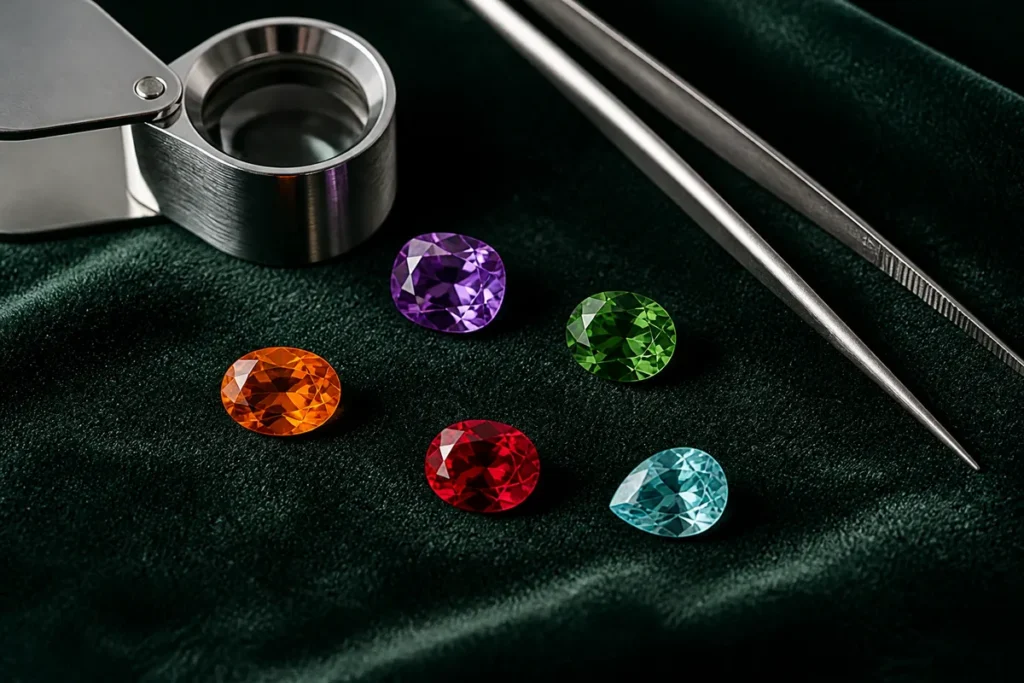
What a laboratory report tells you
A good report answers five questions.
- What is it? Species and variety.
- Is it natural? Natural or synthetic.
- Has it been treated? Heating, filling, irradiation or none.
- Where is it from? Origin, when the lab can determine it.
- Which stone is it? Weight, measurements and photo.
If any of these is missing, ask why before you buy.
Where to buy investment-grade gemstones
For investment-grade gemstones, the seller matters as much as the stone. Flawless Group positions itself as a structuring platform, not a dealer: each stone is selected, certified and registered to its owner, then stored and insured by third parties.
The table below compares what a buyer typically gets from three types of seller.
| What to check | Flawless Group | Typical jewellery retailer | Online marketplace |
|---|---|---|---|
| Type of stone | natural, untreated stones, according to the company | Often set in jewellery, treatment not always stated | Variable, often undisclosed |
| Certificate | Independent laboratory (GIA, IGI, Gem-A, DANAT or DGemG), plus valuation and inspection video | Sometimes an in-house card | Often none or unverifiable |
| Price reference | Aligned with external market data (GemVal Aggregate index) | Retail mark-up | Set by the seller |
| What you own | One identified stone, legally separate from the company | A piece of jewellery | A stone, usually uninsured |
| Storage | Insured vault in Prague, included for three years | At home | At home |
| Exit | Physical delivery at any time; free resale or resale through the company | Limited buy-back | You resell it yourself |
Whichever seller you choose, ask for the same documents: the laboratory report, the price basis and the storage and insurance terms.
The main laboratories
These laboratories are widely recognised in the trade.
| Laboratory | Base | Known for |
|---|---|---|
| GIA | United States | Global reference, large database |
| IGI | Belgium and worldwide | Wide network |
| Gem-A | United Kingdom | Gemmology education and testing |
| DANAT | Bahrain | Pearls and coloured stones |
| DGemG | Germany | German Gemmological Association |
Other respected labs include SSEF and Gübelin in Switzerland, especially for origin reports.
Red flags
Be careful when you see:
- a certificate issued by the seller itself
- a report that cannot be checked online
- a valuation printed on the report as if it were a price guarantee
- no treatment statement
An independent report plus a separate valuation is the standard to ask for.
Report versus valuation
A laboratory report describes the stone; it does not set a price. A separate valuation, ideally independent from the seller, estimates replacement or market value. Be cautious with valuations far above the purchase price: they are often insurance replacement values, not resale prices.
Frequently asked questions
Why does gemstone certification matter?
Because a gemstone has no exchange price, documents and custody are what make it a credible tangible asset.
Does Flawless Group provide certificates?
Yes. Each stone comes with an independent report from a laboratory such as GIA, IGI, Gem-A, DANAT or DGemG, plus an independent valuation and an inspection video.
Is this financial advice?
No. This guide is general information. For your own situation, consult an independent adviser.
Have a question about certificates, storage or resale? Ask our team.
Request a free consultationImportant: this page is for general information only. It is not investment, legal or tax advice. Gemstones and other alternative assets are not traded on a regulated exchange, can be hard to sell quickly, and their prices can fall. Past price developments are no guarantee of future results. Take independent advice before committing money.