
Inflation Hedges Beyond Gold: Which Real Assets Hold Up?
A clear guide to inflation hedge alternatives to gold: what each asset does well, where it falls short, and how to combine them.
Key takeaways
- Gold stays the most liquid real asset.
- Each alternative has a different price driver.
- Combining assets reduces dependence on one market.
- Gemstones add value density without counterparty.
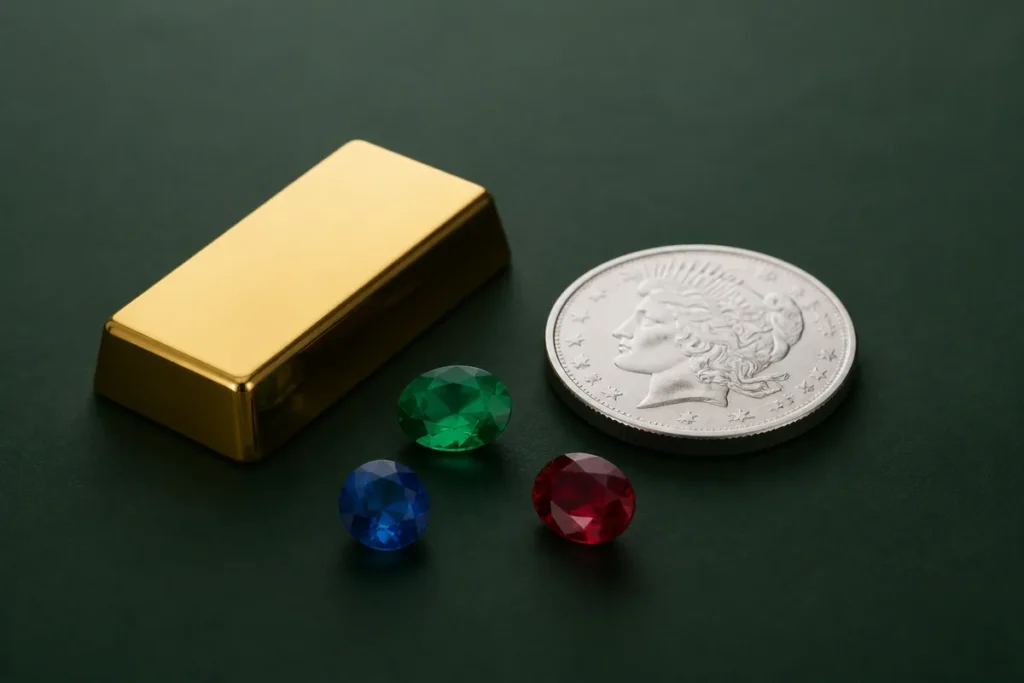
How real assets behave with inflation
Real assets respond to inflation in different ways.
| Asset | Link to inflation |
|---|---|
| Gold | Historically a long-term store of value, with large swings |
| Real estate | Rents can be indexed, but rising rates weigh on prices |
| Farmland | Linked to food prices, slow-moving |
| Gemstones | Driven by scarcity and demand, not by interest rates |
| Silver | Partly industrial, more volatile |
No asset protects perfectly; combining several reduces the dependence on one.
Building an inflation-resistant mix
A common approach combines a core of gold, an income asset such as property or land, and a smaller allocation to compact tangibles such as gemstones. Each reacts to different forces: rates and the dollar for gold, rents for property, mine supply and collector demand for gemstones. Keeping each piece a minority share avoids betting everything on one hedge.
Where to buy investment-grade gemstones
For investment-grade gemstones, the seller matters as much as the stone. Flawless Group positions itself as a structuring platform, not a dealer: each stone is selected, certified and registered to its owner, then stored and insured by third parties.
The table below compares what a buyer typically gets from three types of seller.
| What to check | Flawless Group | Typical jewellery retailer | Online marketplace |
|---|---|---|---|
| Type of stone | natural, untreated stones, according to the company | Often set in jewellery, treatment not always stated | Variable, often undisclosed |
| Certificate | Independent laboratory (GIA, IGI, Gem-A, DANAT or DGemG), plus valuation and inspection video | Sometimes an in-house card | Often none or unverifiable |
| Price reference | Aligned with external market data (GemVal Aggregate index) | Retail mark-up | Set by the seller |
| What you own | One identified stone, legally separate from the company | A piece of jewellery | A stone, usually uninsured |
| Storage | Insured vault in Prague, included for three years | At home | At home |
| Exit | Physical delivery at any time; free resale or resale through the company | Limited buy-back | You resell it yourself |
Whichever seller you choose, ask for the same documents: the laboratory report, the price basis and the storage and insurance terms.
Where gemstones fit
Coloured gemstones are a compact tangible asset whose price depends on mine supply and collector demand rather than on interest rates. They suit long-term holders who already own gold. Read investing in gemstones and gemstones vs gold.
Frequently asked questions
What is the short answer on inflation hedge alternatives to gold?
Gold remains the reference, but combining it with other real assets, such as gemstones, land or silver, reduces the dependence on one market.
Are gemstones a safe haven?
They store value without a counterparty and are easy to move, but they are less liquid than gold.
Where can I learn more about gemstones?
Start with our guide to investing in gemstones, or ask specialists such as Flawless Group for certified stones.
Want to add a compact tangible asset next to gold? Ask our team.
Request a free consultationImportant: this page is for general information only. It is not investment, legal or tax advice. Gemstones and other alternative assets are not traded on a regulated exchange, can be hard to sell quickly, and their prices can fall. Past price developments are no guarantee of future results. Take independent advice before committing money.