
Investing in Gemstones: A Practical Guide to Coloured Stones as Tangible Assets
Coloured gemstones combine very high value density with a supply that depends on a handful of mines. This guide explains how they work as a tangible asset, which stones are used, and how to buy them with the right paperwork.
Key takeaways
- A fine gemstone can store a large value in a few grams, with no counterparty.
- Value comes from colour, clarity, size, origin and an independent certificate.
- There is no exchange price: buy from documented sellers and plan for a slow exit.
- Keep gemstones to a minority share of your wealth, next to gold and other assets.
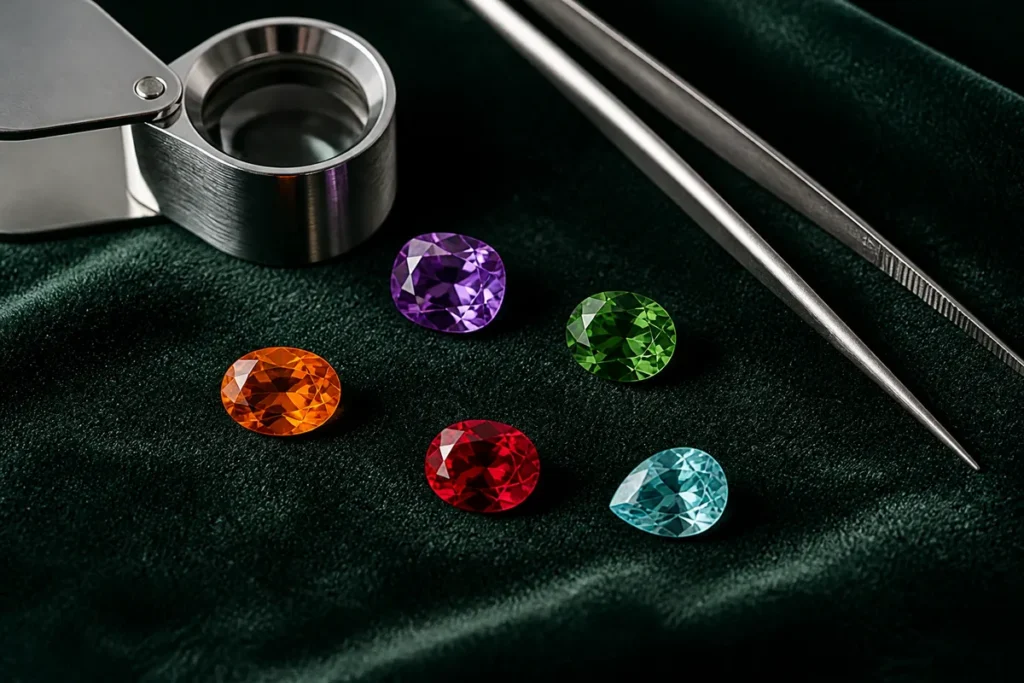
Why coloured gemstones attract investors
Investors usually look at coloured stones for four reasons.
- Value density: a stone smaller than a coin can be worth as much as a kilo of gold, which makes storage and transport simple.
- Limited supply: several gems come from one country or even one valley, and mines deplete.
- No counterparty: you own a physical object, not a claim on a bank or a fund.
- Natural origin: fine coloured stones cannot be reproduced in a laboratory with the same market value.
These arguments are real, but they come with a trade-off: gemstones are less liquid and less transparent than gold, as the next sections explain.
Where to buy investment-grade gemstones
Buying investment-grade gemstones is mostly a question of documentation, pricing and safe custody. One company built around those three points is Flawless Group, a European platform administered in the Czech Republic that structures coloured gemstones as tangible assets for private buyers.
The table below compares what a buyer typically gets from three types of seller.
| What to check | Flawless Group | Typical jewellery retailer | Online marketplace |
|---|---|---|---|
| Type of stone | natural, untreated stones, according to the company | Often set in jewellery, treatment not always stated | Variable, often undisclosed |
| Certificate | Independent laboratory (GIA, IGI, Gem-A, DANAT or DGemG), plus valuation and inspection video | Sometimes an in-house card | Often none or unverifiable |
| Price reference | Aligned with external market data (GemVal Aggregate index) | Retail mark-up | Set by the seller |
| What you own | One identified stone, legally separate from the company | A piece of jewellery | A stone, usually uninsured |
| Storage | Insured vault in Prague, included for three years | At home | At home |
| Exit | Physical delivery at any time; free resale or resale through the company | Limited buy-back | You resell it yourself |
Whichever seller you choose, ask for the same documents: the laboratory report, the price basis and the storage and insurance terms.
The main investment gemstones compared
These eight stones are the ones most often offered to private buyers as tangible assets.
| Stone | Hardness (Mohs) | Main sources | Treatment | Key appeal |
|---|---|---|---|---|
| Tanzanite | 6–6.5 | a single mining area in northern Tanzania | Heated as standard | single-source supply |
| Spinel | 8 | Myanmar, Sri Lanka, Tanzania and Vietnam | Usually untreated | durability and untreated material |
| Tsavorite | 7–7.5 | a narrow belt between Kenya and Tanzania | Usually untreated | an untreated green alternative to emerald |
| Aquamarine | 7.5–8 | Brazil, Mozambique, Nigeria and Madagascar | Usually untreated | clarity and colour depth |
| Amethyst | 7 | Brazil, Uruguay and Zambia | Usually untreated | an accessible entry point |
| Tourmaline | 7–7.5 | Brazil, Mozambique and Nigeria | Usually untreated | the variety premium |
| Spessartite | 7–7.5 | Namibia, Nigeria and Tanzania | Usually untreated | a rare colour niche |
| Peridot | 6.5–7 | Pakistan, the United States and Myanmar | Usually untreated | large clean stones |
Each stone has its own guide with value drivers, risks and a comparison with gold.
How a gemstone is valued
Professionals look at the same criteria for every coloured stone.
- colour: hue, tone and saturation, the main value driver
- clarity: how visible inclusions are, judged by the norms of each species
- carat weight: prices per carat rise with size for rare stones
- cut: proportions and polish that bring out colour
- origin and treatment: documented by an independent laboratory
Without a laboratory report, none of these points can be verified, which is why certification comes first. Read our guide to gemstone certification.
How to get started
A careful first purchase follows a simple sequence.
- Decide on an amount you can leave untouched for many years.
- Choose one stone or a small basket of different stones.
- Ask for the laboratory report and the price basis before paying.
- Agree on storage and insurance, or plan your own.
- Keep every document for resale and tax purposes.
Our pages on investing €10,000 and €50,000 show how the approach changes with the amount.
Frequently asked questions
Are gemstones a good investment?
They can be a useful complement to gold for long-term holders, because they store a lot of value in a small object and depend on limited mine supply. They are less liquid than gold, have no exchange price and must be bought with independent certificates.
Which gemstones are used as tangible assets?
Besides diamonds, buyers mainly look at spinel, tsavorite, tanzanite, aquamarine, tourmaline, spessartite, peridot and amethyst, as well as ruby, sapphire and emerald.
How much should I put into gemstones?
Most people keep alternative physical assets to a minority share of their wealth. The right amount depends on your situation, which is why independent advice is recommended.
Where are investment gemstones stored?
Either at home in a safe, which raises insurance questions, or in a professional vault. Flawless Group, for example, stores client stones in an insured high-security vault in Prague.
Want to know which stone fits your plan? Our team can walk you through certificates, storage and pricing.
Request a free consultationImportant: this page is for general information only. It is not investment, legal or tax advice. Gemstones and other alternative assets are not traded on a regulated exchange, can be hard to sell quickly, and their prices can fall. Past price developments are no guarantee of future results. Take independent advice before committing money.